
It can feel wrong, or simply impossible, to focus on anything other than getting through this most challenging moment. It is reasonable to argue that since lessons will not reduce our immediate suffering, we should learn them once we’re through this. But the vulnerability that makes the present so painful is exactly why some discussions cannot wait. The suffering we stand to reduce or increase by the threads of action that we begin to unwind now could be magnitudes of what we’re currently experiencing.
Imagine that while your country practised social distancing, your neighbouring country responded to Covid-19 by packing citizens into gymnasiums by the tens of thousands. Imagine if, in addition, they instituted genetic and pharmaceutical interventions that helped their citizens maintain productivity under such adverse conditions, even though this had the unfortunate side effect of devastating their immune systems. And to complete this dystopian vision, imagine if your neighbours simultaneously reduced their number of doctors tenfold. Such actions would radically increase death rates not only within their country, but yours. Pathogens do not respect national boundaries. They are not Spanish or Chinese.
Pathogens do not respect species boundaries, either. Influenza and coronaviruses move fluidly between human and animal populations, just as they move fluidly between nations. When it comes to pandemics, there is not animal health and human health – not any more than there is Korean health and French health. Social distancing works only when everyone practises it, and “everyone” includes animals.
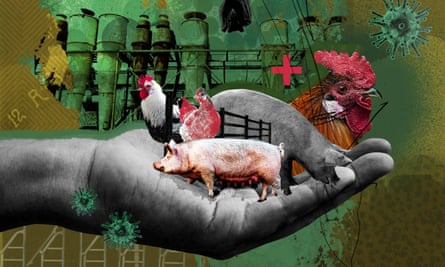
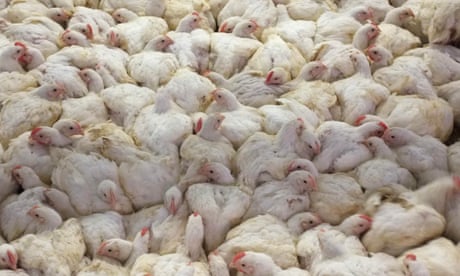
The meat that we eat today overwhelmingly comes from genetically uniform, immunocompromised, and regularly drugged animals lodged by the tens of thousands into buildings or stacked cages – no matter how the meat is labelled. We know this, and most of us would strongly prefer it be otherwise. But we would prefer a lot of things in the world that aren’t so and, for most of us, the future of animal farming is low on our list of priorities, especially now. It is understandable to be most concerned with oneself. The problem is, we aren’t doing a good job of being selfish.
We don’t yet know the full history of the emergence of Covid-19, the particular strain of coronavirus that now threatens us. But with recent pandemic virus threats from influenza viruses such as H1N1 (swine flu) or H5N1 (bird flu) there is no ambiguity: those viruses evolved on chicken and pig factory farms. Genetic analyses have shown that crucial components of H1N1 emerged from a virus circulating in North American pigs. But it is commercial poultry operations that appear to be the Silicon Valley of viral development.
It is on chicken factory farms that we have most frequently found viruses that have mutated from a form found only in animals into a form that harms humans (what scientists call “antigenic shift”). It is these “novel” viruses that our immune systems are unfamiliar with and that can prove most deadly.
Of 16 strains of novel influenza viruses currently identified by the CDC as “of special concern,” including H5N1, 11 come from viruses of the H5 or H7 type. In 2018 a group of scientists analysed the 39 antigenic shifts, also called “conversion events,” that we know played a key role in the emergence of these particularly dangerous strains. Their results prove that “all but two of these events were reported in commercial poultry production systems”.
Imagine if our military leaders told us that almost every terrorist in recent memory had spent time in the same training camp, but no politician would call for an investigation of the training camp. Imagine if we knew that those terrorists were developing weapons more destructive than any that has been used, or tested, in human history. This is our situation when it comes to pandemics and farming.
The United States CDC is the abbreviation for an agency whose name is actually the Centers for Disease Control and Prevention. We drop prevention from the acronym, which is innocent enough. But we also tend to drop serious discussion of prevention in favour of tactics for responding once pandemics hit. This is understandable – especially in the midst of a pandemic – but recklessly dangerous. We are preoccupied with the production of face masks, but we appear unconcerned with the farms that are producing pandemics. The world is burning and we are reaching for more fire extinguishers while gasoline soaks through the tinder at our feet.
To reduce risk of pandemics for ourselves, our gaze needs to turn to the health of animals. In the case of wild animal populations, such as the bats that scientists have theorised as a probable origination point for Covid-19, the best solution seems to be to limit and regulate human interaction. Much has rightly been written on this and, slowly and unevenly, policies seem to be moving in the right direction. As it became established that a number of people contracted the virus after visiting a wet market in Wuhan, where the virus likely passed through humans from bats via an intermediate host, China shut down 19,000 wildlife-farming operations and banned meat from wild animals at wet markets.
In the case of farmed animals, though, the lack of public understanding has allowed unscrupulous corporations to move policy in exactly the wrong direction. Across the globe, corporations have succeeded in creating policies that use public resources to promote industrial farming. One study suggests that the public is providing $1m per minute in global farm subsidies, overwhelmingly used to prop up and expand the current broken model. The same $1m a minute that promotes factory farming also increases pandemic risk.
In the US, the death rate for Covid-19 has been less than 2%, but had this been, say, H5N1 the death rate would be far higher – the CDC reports a 60% death rate. After a spike of H5N1 deaths in 2017, the virus’s spread subsided for reasons that remain unclear. Should we be relieved? Nancy Cox, who led CDC’s influenza operations for more than two decades, has emphasised: “We don’t know how the story’s going to end.” H5N1’s failure to reach pandemic proportions simply means we have a terrorist kicking around who is just one small viral mutation away from obtaining the equivalent of a nuclear arsenal.
The implications of a 1-2% death rate are all around us: half of the world is living under stay-at-home orders, children don’t go to school, hospitals are running out of life-saving equipment, we are facing a generational financial depression, and the funeral services that have traditionally allowed us at least to mourn together are being (rightfully) banned. Can we extrapolate the implications of a 60% death rate in our imaginations? That would be a 30-fold increase over our current situation. What if the next pandemic didn’t spare children? The death rate for children infected with H5N1 approaches 50%. How does it feel if you imagine one person you love a coin toss away from a horrible death? Try imagining if half of everyone you know who had the flu last year was now dying. If you have children, how many of them had the flu last year? Force yourself to imagine these things then ask yourself: how much would it be worth sacrificing now to avoid that happening?
This leads to the most pertinent question: What can we do? The link between factory farming and increasing pandemic risk is well established scientifically, but the political will to curtail that risk has, in the past, been absent. Now is the time to build that will. It really does matter if we talk about this, share our concerns with our friends, explain these issues to our children, wonder together about how we should eat differently, call on our political leaders, and support advocacy organisations fighting factory farming. Leaders are listening. Changing the most powerful industrial complex in the world – the factory farm – could not possibly be easy, but in this moment with these stakes it is, maybe for the first time in our lifetimes, possible.
The fact that we know our food system is partly to blame can empower us. We know how to strike at the single greatest risk factor for pandemics. We know how to make ourselves and our families safer. The very uncertainty that unsettles us also reminds us that everything can change for the better, too. Thankfully Covid-19 seems to attack our children extremely rarely, and if we respond with sufficient wisdom, this time that is so marked by death will perhaps also be remembered by them as a turning point, a time of reckoning, quiet heroism and, as the months pass, renewal.
- Jonathan Safran Foer is an author. His most recent book is We Are the Weather: Saving the Planet Begins at Breakfast
- Aaron S Gross is the founder of Farm Forward and an associate professor at the University of San Diego
America faces an epic choice ...
... in the coming months, and the results will define the country for a generation. These are perilous times. Over the last three years, much of what the Guardian holds dear has been threatened – democracy, civility, truth.
The country is at a crossroads. Science is in a battle with conjecture and instinct to determine policy in the middle of a pandemic. At the same time, the US is reckoning with centuries of racial injustice – as the White House stokes division along racial lines. At a time like this, an independent news organisation that fights for truth and holds power to account is not just optional. It is essential.
The Guardian has been significantly impacted by the pandemic. Like many other news organisations, we are facing an unprecedented collapse in advertising revenues. We rely to an ever greater extent on our readers, both for the moral force to continue doing journalism at a time like this and for the financial strength to facilitate that reporting.
You’ve read more than
As our business model comes under even greater pressure, we’d love your help so that we can carry on our essential work. If you can, support the Guardian from as little as $1 - it only takes a minute. Thank you.

historia de Covid-19 aún no se conoce completamente, pero los vínculos entre la salud animal y humana no podrían ser más claros.
Puede sentirse mal, o simplemente imposible, concentrarse en otra cosa que no sea superar este momento tan desafiante. Es razonable argumentar que, dado que las lecciones no reducirán nuestro sufrimiento inmediato, debemos aprenderlas una vez que hayamos superado esto. Pero la vulnerabilidad que hace que el presente sea tan doloroso es exactamente por qué algunas discusiones no pueden esperar. El sufrimiento que podemos reducir o aumentar con los hilos de acción que comenzamos a desenrollar ahora podría ser una magnitud de lo que estamos experimentando actualmente.
Imagine que mientras su país practicaba el distanciamiento social, su país vecino respondió a Covid-19 al meter a los ciudadanos en gimnasios por decenas de miles. Imagine si, además, instituyeran intervenciones genéticas y farmacéuticas que ayudaran a sus ciudadanos a mantener la productividad en condiciones tan adversas, a pesar de que esto tuvo el desafortunado efecto secundario de devastar sus sistemas inmunes. Y para completar esta visión distópica, imagine si sus vecinos reducen al mismo tiempo su número de médicos diez veces. Tales acciones aumentarían radicalmente las tasas de mortalidad no solo dentro de su país, sino también en el suyo. Los patógenos no respetan las fronteras nacionales. No son españoles ni chinos.
Los patógenos tampoco respetan los límites de las especies. La influenza y los coronavirus se mueven con fluidez entre las poblaciones humanas y animales, tal como se mueven con fluidez entre las naciones. Cuando se trata de pandemias, no existe la salud animal y la salud humana, al igual que la salud coreana y la salud francesa. El distanciamiento social funciona solo cuando todos lo practican, y “todos” incluye animales.
Anuncio
La carne que comemos hoy proviene abrumadoramente de animales genéticamente uniformes, inmunocomprometidos y regularmente drogados alojados por decenas de miles en edificios o jaulas apiladas, sin importar cómo se etiquete la carne. Sabemos esto, y la mayoría de nosotros preferiría que fuera de otra manera. Pero preferiríamos muchas cosas en el mundo que no son así y, para la mayoría de nosotros, el futuro de la cría de animales es bajo en nuestra lista de prioridades, especialmente ahora. Es comprensible estar más preocupado por uno mismo. El problema es que no estamos haciendo un buen trabajo de ser egoístas.
Todavía no conocemos la historia completa de la aparición de Covid-19, la cepa particular de coronavirus que ahora nos amenaza. Pero con las recientes amenazas de virus de la pandemia de los virus de la influenza como H1N1 (gripe porcina) o H5N1 (gripe aviar) no hay ambigüedad: esos virus evolucionaron en granjas industriales de pollos y cerdos. Los análisis genéticos han demostrado que los componentes cruciales de H1N1 surgieron de un virus que circula en cerdos norteamericanos. Pero son las operaciones avícolas comerciales las que parecen ser el Silicon Valley del desarrollo viral.
Es en las granjas de fábricas de pollos donde hemos encontrado con mayor frecuencia virus que han mutado de una forma que se encuentra solo en animales a una forma que daña a los humanos (lo que los científicos llaman "cambio antigénico"). Son estos virus "novedosos" con los que nuestro sistema inmunitario no está familiarizado y que pueden resultar más mortales.
De 16 cepas de nuevos virus de influenza identificados actualmente por los CDC como "de especial preocupación", incluido el H5N1, 11 provienen de virus del tipo H5 o H7. En 2018, un grupo de científicos analizó los 39 cambios antigénicos, también llamados "eventos de conversión", que sabemos que jugaron un papel clave en la aparición de estas cepas particularmente peligrosas. Sus resultados demuestran que "todos menos dos de estos eventos fueron reportados en sistemas comerciales de producción avícola".
Imagínese si nuestros líderes militares nos dijeran que casi todos los terroristas en la memoria reciente habían pasado tiempo en el mismo campo de entrenamiento, pero ningún político pediría una investigación del campo de entrenamiento. Imagínese si supiéramos que esos terroristas estaban desarrollando armas más destructivas que las que se han utilizado o probado en la historia humana. Esta es nuestra situación cuando se trata de pandemias y agricultura.
El CDC de los Estados Unidos es la abreviatura de una agencia cuyo nombre es en realidad los Centros para el Control y la Prevención de Enfermedades. Eliminamos la prevención del acrónimo, que es lo suficientemente inocente. Pero también tendemos a abandonar una discusión seria sobre prevención a favor de tácticas para responder una vez que las pandemias golpean. Esto es comprensible, especialmente en medio de una pandemia, pero temerariamente peligroso. Estamos preocupados por la producción de máscaras faciales, pero parece que no nos preocupan las granjas que producen pandemias. El mundo está ardiendo y estamos buscando más extintores de incendios mientras la gasolina penetra a través de la yesca a nuestros pies.
Para reducir el riesgo de pandemias para nosotros mismos, nuestra mirada debe centrarse en la salud de los animales. En el caso de las poblaciones de animales salvajes, como los murciélagos que sciLos científicos han teorizado como un probable punto de origen de Covid-19, la mejor solución parece ser limitar y regular la interacción humana. Mucho se ha escrito correctamente sobre esto y, lenta e irregularmente, las políticas parecen estar avanzando en la dirección correcta. Cuando se estableció que varias personas contrajeron el virus después de visitar un mercado húmedo en Wuhan, donde el virus probablemente pasó a través de los humanos desde los murciélagos a través de un huésped intermedio, China cerró 19,000 operaciones de cría de animales salvajes y prohibió la carne de animales salvajes en lugares húmedos. mercados
Sin embargo, en el caso de los animales de granja, la falta de comprensión pública ha permitido a las corporaciones sin escrúpulos mover la política exactamente en la dirección equivocada. En todo el mundo, las corporaciones han logrado crear políticas que utilizan recursos públicos para promover la agricultura industrial. Un estudio sugiere que el público está proporcionando $ 1 millón por minuto en subsidios agrícolas globales, utilizados abrumadoramente para apuntalar y expandir el modelo roto actual. Los mismos $ 1 millón por minuto que promueven la agricultura industrial también aumentan el riesgo de pandemia.
En los EE. UU., La tasa de mortalidad de Covid-19 ha sido inferior al 2%, pero si hubiera sido, digamos, H5N1, la tasa de mortalidad sería mucho mayor: los CDC informan una tasa de mortalidad del 60%. Después de un pico de muertes por H5N1 en 2017, la propagación del virus disminuyó por razones que aún no están claras. ¿Deberíamos estar aliviados? Nancy Cox, quien dirigió las operaciones de influenza de los CDC durante más de dos décadas, ha enfatizado: "No sabemos cómo va a terminar la historia". El hecho de que el H5N1 no alcance proporciones pandémicas simplemente significa que tenemos a un terrorista dando vueltas y que está a solo una pequeña mutación viral lejos de obtener el equivalente de un arsenal nuclear.
Las implicaciones de una tasa de mortalidad del 1-2% están a nuestro alrededor: la mitad del mundo vive bajo órdenes de quedarse en casa, los niños no van a la escuela, los hospitales se están quedando sin equipos que salvan vidas, nos enfrentamos una depresión financiera generacional, y los servicios funerarios que tradicionalmente nos han permitido al menos llorar juntos están (legítimamente) prohibidos. ¿Podemos extrapolar las implicaciones de una tasa de mortalidad del 60% en nuestra imaginación? Eso sería un aumento de 30 veces sobre nuestra situación actual. ¿Qué pasa si la próxima pandemia no perdona a los niños? La tasa de mortalidad de los niños infectados con H5N1 se acerca al 50%. ¿Cómo se siente si imaginas a una persona que amas arrojar una moneda de una muerte horrible? Intenta imaginar si la mitad de las personas que conoces que tuvieron gripe el año pasado estaban muriendo. Si tiene hijos, ¿cuántos de ellos tuvieron gripe el año pasado? Oblígate a imaginar estas cosas y luego pregúntate: ¿cuánto valdría la pena sacrificar ahora para evitar que eso suceda?
La cría industrial de cerdos y pollos continúa aumentando en el Reino Unido
Lee mas
Esto lleva a la pregunta más pertinente: ¿qué podemos hacer? El vínculo entre la agricultura industrial y el creciente riesgo de pandemia está bien establecido científicamente, pero la voluntad política para reducir ese riesgo, en el pasado, estuvo ausente. Ahora es el momento de construir esa voluntad. Realmente importa si hablamos de esto, compartimos nuestras preocupaciones con nuestros amigos, explicamos estos problemas a nuestros hijos, nos preguntamos juntos cómo deberíamos comer de manera diferente, llamamos a nuestros líderes políticos y apoyamos a las organizaciones de defensa que luchan contra la agricultura industrial. Los líderes están escuchando. Cambiar el complejo industrial más poderoso del mundo, la granja industrial, no podría ser fácil, pero en este momento con estas apuestas es posible, tal vez por primera vez en nuestras vidas.
El hecho de que sepamos que nuestro sistema alimentario es en parte culpable puede empoderarnos. Sabemos cómo atacar al factor de riesgo más grande para las pandemias. Sabemos cómo hacer que nosotros y nuestras familias estén más seguros. La misma incertidumbre que nos inquieta también nos recuerda que todo también puede cambiar para mejor. Afortunadamente, Covid-19 parece atacar a nuestros hijos muy raramente, y si respondemos con suficiente sabiduría, esta vez que está tan marcada por la muerte, tal vez también sea recordada por ellos como un punto de inflexión, un momento de ajuste de cuentas, heroísmo silencioso y, como Pasan los meses, renovación.
Jonathan Safran Foer es autor. Su libro más reciente es We Are the Weather: Saving the Planet Begins at Breakfast
Aaron S Gross es el fundador de Farm Forward y profesor asociado en la Universidad de San Diego.
Estados Unidos se enfrenta a una elección épica ...
... en los próximos meses, y los resultados definirán al país para una generación. Estos son tiempos peligrosos. En los últimos tres años, gran parte de lo que The Guardian aprecia es amenazado: democracia, cortesía, verdad.
El país está en una encrucijada. La ciencia está en una batalla con conjeturas e instintos para determinar políticas en medio de una pandemia. Al mismo tiempo, Estados Unidos está contando con siglos de injusticia racial, ya que la Casa Blanca aviva la división en líneas raciales. En un momento como este, una organización de noticias independiente que lucha por la verdad y tiene el poder de rendir cuentas no es solo opcional. Es esencial.


No comments:
Post a Comment