
(Espanol/English)
A Purely Cuban Invention: the Varaentierra. A Cuban Invention Against Cyclones/Un Invento Netamente Cubano: el Varaentierra. Un invento Cubano Contra los Ciclones


Eddi de la Pera
Desde tiempos inmemoriales los ciclones tropicales han hecho de Cuba,
junto a otras islas del Caribe, los Estados Unidos y México, los principales
blancos de sus trayectorias. Ya los pobladores taínos de Cuba los denominaban
como “espíritus del mal” y los mayas, con el mismo sentido, dieron nombre
a ese maléfico dios, llamándole “Huranken”, el dios de las tormentas,
devenido hoy en Huracán, Hurricane o Ouragan, en las tres lenguas
modernas principales que se hablan en nuestra área.
La necesidad de protegerse y sobrevivir a esos terribles vientos junto
a las lluvias torrenciales, convirtieron a las cuevas en el primer
refugio natural de los aborígenes. Las cuevas permitían la vida
normal por un tiempo más o menos prolongado e incluso
permitían cocinar y hacer otras labores, pero en los
lugares donde no habían cuevas cercanas o que
tuvieran las condiciones necesarias, la inventiva
poco a poco floreció.
Y de ahí surgió un invento netamente cubano: el Varaentierra.
En tiempos antiguos se le llamó Bahío o Bohío, o también
Rancho de Vara en Tierra. Sin embargo, el uso popular fue
reduciendo la frase a simplemente “Varentierra”.
Se trata de una especie de habitación más reducida,
provisional e improvisada, que si bien en antaño era
utilizada por los campesinos para preservarse de la
intemperie o habitar transitoriamente, luego se convirtió
en una construcción permanente que servía a los guajiros
cubanos para protegerse de las tormentas tropicales o huracanes.
En tiempos normales funcionaban también para guardar
vituallas, materiales, aperos de labranza y hasta sus cosechas.
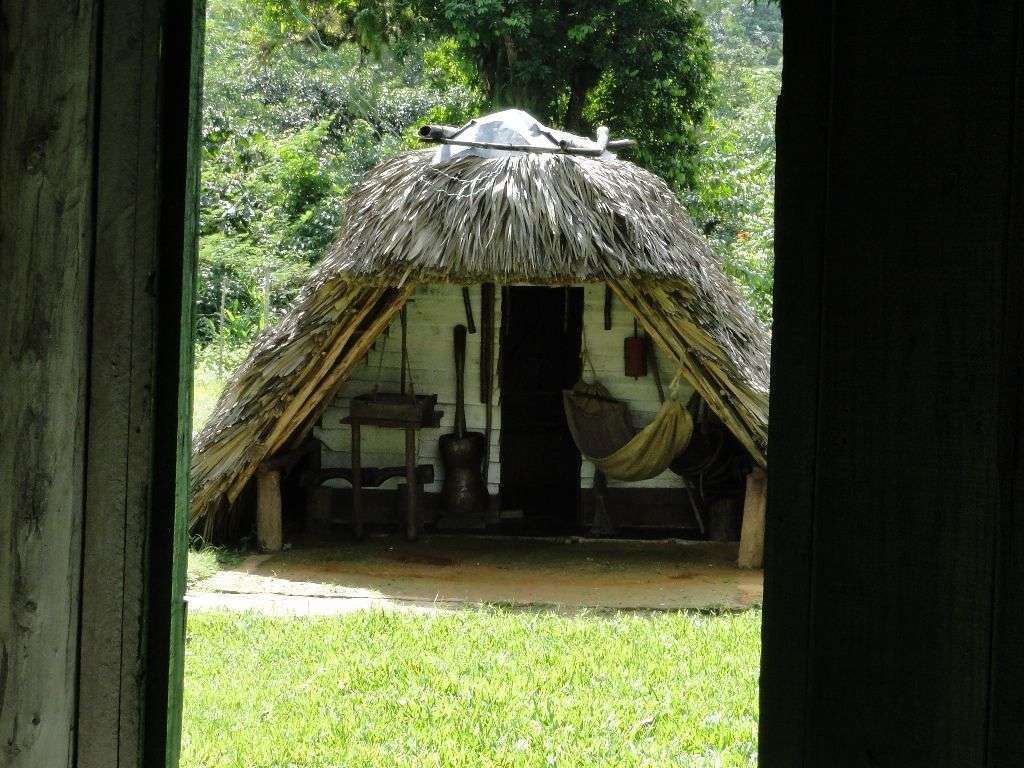
El Varaentierra posee un techo de dos aguas, de yagua o guano,
con la techumbre o cobija en forma de un ángulo diedro, como
si fuese el techo o caballete de una casa sobre la tierra, a modo
de naipe doblado por el medio y puesto bocabajo.
No tiene horcones ni paredes, sino sólo dos aguas o
aleros que descansan en el suelo, sin más respiradero
que la puerta de enfrente. Típicamente se construía en
un terreno algo más elevado, para evitar la entrada de
agua de lluvia a su interior. Usualmente se prefería
para ubicarlo el fondo del bohío o un lugar cercano
a donde viviera la familia, y se profundizaba su piso
hasta un metro por debajo de la superficie. El techo
bajo le permite escapar a los efectos del viento.
Un Varaentierra puede describirse prácticamente
como un hueco en la tierra con un techo de dos
aguas encima, o lo que pudiera decirse como
“una casa sin paredes”. Sin embargo, dentro del
rústico espacio se encontraban todos los medios
necesarios para la convivencia y sobrevivir al paso
de un evento meteorológico extremo.
Con un área de unos 12 metros cuadrados, y
escasos metro y medio de altura, del piso al
caballete, en el recinto se puede albergar a
toda la familia y además a varios vecinos
que pudieran llegar, según el tamaño que tuviese.
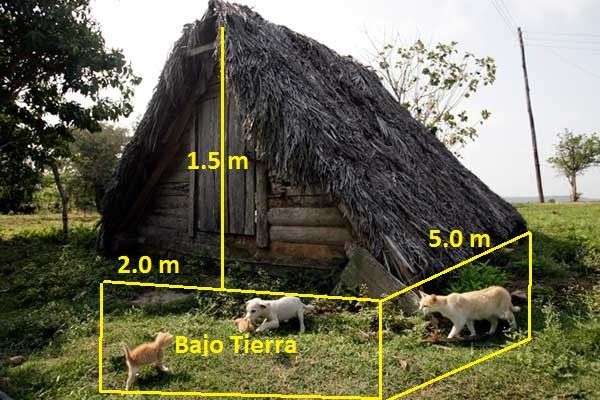
Tengo una anécdota personal: si no hubiera sido por un
Varaentierra yo no estuviera escribiendo estás letras ni
se me hubiera visto nunca en televisión.
Cuando pasó el terrible huracán de 1926 en La Habana,
en Jibacoa del Norte, hoy provincia de Mayabeque, mi
abuelo materno, campesino español que labraba su
finca allí, llevó a mi abuela y sus cinco hijos, entre
ellos a mi madre que tenía sólo dos años, a guarecerse
del huracán en el Varaentierra que había construido
previsoramente tiempo atrás, cercano a la vivienda,
como era la costumbre de la época.
Sin aviso previo y con el huracán soplando en plena intensidad, salieron del bohío para el refugio en cadena, agarrados de las manos. En el maremágnum que sobrevino, la que sería mi madre se soltó de la cadena y se perdió. Mi abuelo, a duras penas, entre el fortísimo viento y la pared de lluvia que caía, con visibilidad casi nula, la encontró y llevó al refugio donde ya estaban los demás. Así salvaron sus vidas, pues el bohío en que vivía la familia quedó totalmente destruido.
El Varaentierra, es parte consustancial de la cultura arquitectónica de nuestros campos, pero casi se fue perdiendo junto a nuestros abuelos y bisabuelos. Varios años sin huracanes de importancia y la dinámica de la vida, tendían a acabar con su existencia. Pero una nueva etapa de actividad ciclónica iniciada en 1995 y la continuación de nueve huracanes de gran intensidad que azotaron a Cuba en pocos años, los han hecho renacer como una necesidad, un aporte de los campesinos cubanos a la protección de la vida ante el azote de los huracanes.
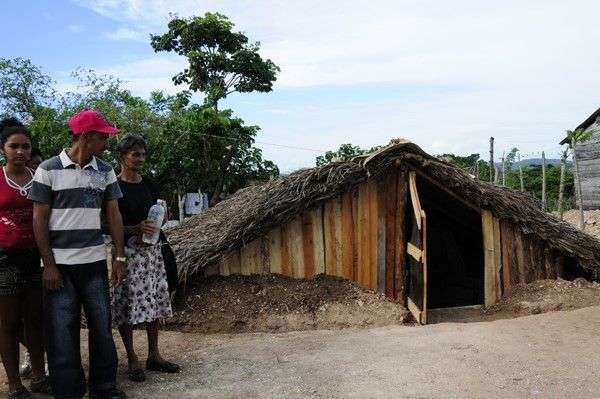
Nueva versión del Varaentierra, para protección en caso de huracanes. Foto: José Rubiera
(English)
A Purely Cuban Invention: the Varaentierra. A Cuban Invention Against Cyclones
The need to protect themselves and survive those terrible winds together with the torrential rains,
turned the caves into the first natural refuge of the aborigines. The caves allowed normal life for
a more or less prolonged time and even allowed cooking and doing other tasks, but in places
where there were no caves nearby or that had the necessary conditions, inventiveness gradually
flourished.
And from there came a purely Cuban invention: the Varaentierra.
In ancient times it was called Bahío or Bohío, or also Rancho de Vara en Tierra. However, the
popular use was reducing the phrase to simply "Varentierra".
It is a kind of smaller, provisional and improvised room, which although in the past was used by
the peasants to protect themselves from the elements or live temporarily, later it became a
permanent construction that served the Cuban peasants to protect themselves from the tropical
storms or hurricanes.
In normal times they also functioned to store provisions, materials, farming tools and even their
crops.
Photo: Juan Carlos Dorado (Blog The Steps Found)

The Varaentierra has a gabled roof, made of yagua or guano, with the roof or blanket in the form
of a dihedral angle, as if it were the roof or ridge of a house on earth, like a playing card folded in
the middle and placed upside down
It has no posts or walls, but only two gables or eaves that rest on the ground, with no other vent
than the front door. Typically it was built on a somewhat higher ground, to prevent rainwater from
entering its interior. Usually, the bottom of the bohío or a place close to where the family lived was
preferred, and its floor was deepened up to one meter below the surface. The low ceiling allows
you to escape the effects of the wind.
A Varaentiterra can practically be described as a hole in the ground with a gabled roof on top,
or what could be said as “a house without walls”. However, within the rustic space were all the
necessary means for living together and surviving the passage of an extreme weather event.
With an area of about 12 square meters, and a height of just one and a half meters, from the floor
to the trestle, the enclosure can house the whole family and also several neighbors who may
arrive, depending on its size.
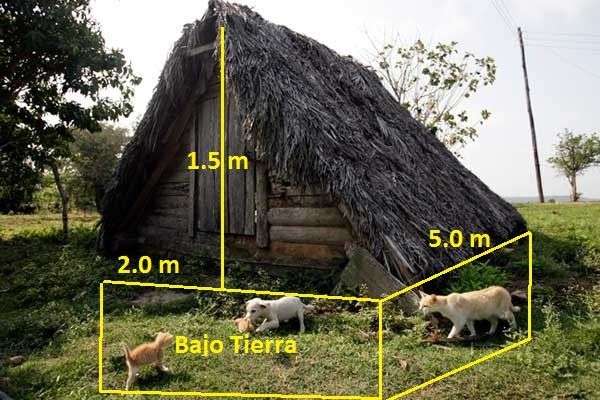
I have a personal anecdote: if it hadn't been for a Varaentierra I wouldn't be writing these lyrics
nor would I have ever been seen on television.
When the terrible hurricane of 1926 passed in Havana, in Jibacoa del Norte, today the province
of Mayabeque, my maternal grandfather, a Spanish peasant who worked his farm there, took my
grandmother and her five children, including my mother who was only two years, to shelter from
the hurricane in the Varaentierra that he had foresight built some time ago, close to the house, as
was the custom of the time.
Without prior notice and with the hurricane blowing at full intensity, they left the bohio for the shelter in a chain, holding hands. In the tidal wave that ensued, the one who would be my mother broke free from the chain and was lost. My grandfather, with great difficulty, between the very strong wind and the wall of rain that was falling, with almost zero visibility, found her and took her to the shelter where the others were already. In this way they saved their lives, since the hut in which the family lived was totally destroyed.
The Varaentierra, is a consubstantial part of the architectural culture of our fields, but it was
almost lost along with our grandparents and great-grandparents. Several years without major
hurricanes and the dynamics of life tended to end their existence. But a new stage of cyclonic
activity that began in 1995 and the continuation of nine hurricanes of great intensity that hit Cuba
in a few years have made them reborn as a necessity, a contribution by Cuban farmers to the
protection of life from the scourge of hurricanes.
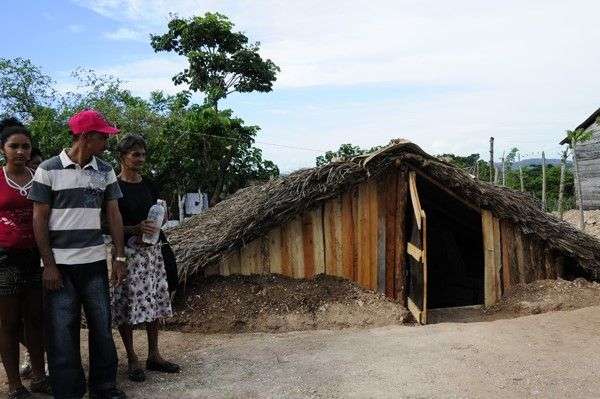
New version of the Varaentierra, for protection in case of hurricanes. Photo: Jose Rubiera


No comments:
Post a Comment