
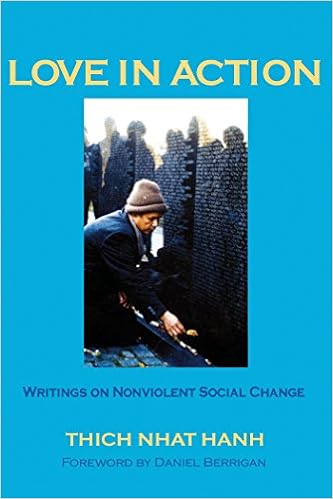
Love in Action is a collection of over two decades of Thich Nhat Hanh’s writing on nonviolence, peace, and reconciliation. Reflecting on the devastation of (the Vietnam War,) he makes the strong argument that mindfulness, insight, and altruistic love are the only sustainable bases for political action. This timeless book is an important resource for those interested in social change.
Excerpt from Thich Nhat Hahn's "Love in Action:"
"Leaders (of nonviolent social justice movements) must create and inspire love for the masses in the hearts of their people. They touch the people by altruistic acts born from their own love. When Nhat Chi Mai self immolated herself because she wanted to be a "torch in the dark night," she moved millions of Vietnamese. The force she engendered was the force of love for non-violent action."

( Nhat Chi Mai Hnat (photo above) was a young Vietnamese Buddhist nun who was part of what THich Nhat Hahn founded and called " Engaged Buddhism" during the Vietnam War.) When she self immolated herself because she wanted to be a "torch in the dark night," she moved millions of Vietnamese and the world The force she engendered was the force of love for non-violent action."--Thich Naht Hahn, global Zen Buddhist peace leader, in his book Love in Action.
Thich Nhat Hahn continuities:
"The nature of the struggle is not a doctrine to be materialized by a program of action; it is communication and love. Thus, its leaders must create and inspire love for the masses in the hearts of their people. They touch the people by altruistic acts born from their own love...
"We have witnessed tragic and heroic scenes of love: a monk seated calmly before advancing tanks; women and children raising bare hands against clubs and grenades; hunger strikes held in patience and silence. Only love and sacrifice can engender love and sacrifice. This chain reaction is essential to the non-violent struggle. Thich Tri Quang did not make strategy; he fasted 100 days. And everyone who passed by the Duy Tan clinic at that time had to hold his breath.
"The usual way to generate force is to create anger, desire,and fear. But these are dangerous sources of energy because they are blind, whereas the force of love springs from awareness, and does not destroy its own aims. Out of love and the willingness to act, strategies and tactics will be created naturally from the circumstances of the struggle. Thus, the problems of strategy and tactics are of secondary importance. They should be posed, but not at the beginning."
"...Our struggle's purpose... [is] the destruction of fanaticism and inhumanity, which are the real enemies of man."
"At a joint press conference with a Buddhist monk, Rev. Dr. Martin Luther King declared, "both the colored people struggling for civil rights in the US and the Buddhist struggling for peace in Vietnam are bound to the cause of peace and social justice, and are determined to sacrifice themselves to achieve their goal."
"Westerners often misunderstand and see self-immolation as and act of violence. To the Vietnamese it is quite the opposite. By accepting extreme suffering, one lights the fires of compassion and awakens the hearts of the people, as Christ did. Among a number of Vietnamese who immolated themselves for peace were Thich Quand Duc, a monk, and Nhat Chi Mai, a yound girl student."
"Another means - the one most often used by Gandhi to communicate with the people - has been fasting. Thousands of Vietnamese, both as individuals and in groups, have fasted to try to end the war. One fasts to pray, to purify one's heart and strengthen the will - or to arouse the silent awareness and compassion of the population. In 1966, Venerable Thich Tri Quang fasted for 100 days, deeply affecting the people of Vietnam.
"There have been other painful sacrifices. In 1963, a girl student named Mai Tuuyet An cut off her hand as a warning to the Diem regime, unleashing tremendous emotion among young people. In 1966, ten university students, Nhat Chi Mai among them, pledged to kill themselves to try to end the war, but the church forbade them. A year later, Nhat Chi Mai burned herself.
"There have been strikes, business licenses returned, resignations of university presidents, deans and professors (40 professors at Hue University), boycotts of classes and refusals to participate in the war. One typically Vietnamese act mentioned earlier has been the carrying of family altars into the streets to oppose tanks, a demonstration of the people's determination to pit the most precious symbols of their traditional values against the instruments of inhumanity and violence.
"Humanist efforts in Vietnam are suppressed by secret police, tear gas, suffocating gas, TNT, grenades, prisons and torture. False nuns and monks infiltrate the Buddhist movement, damaging its prestige and sowing seeds of fear. Extremists are thus encouraged to pervert and destroy the leaders and cadres of non-violent moments. Uncounted numbers of Buddhists and non-Buddhist leaders from all walks of life have been liquidated or sent to prison. In the School of Youth for Social Service, whose only aim is to help the peasants, eight young people have been kidnapped, six killed, eleven seriously wounded. Why? Because they refused to accept American aid or to participate in the war."
"The non-violent struggle in Vietnam goes on - amid vast pain and hardship. The world is just beginning to understand that peace everywhere, as well as the future of Vietnam, is linked to this movement. Its success and its contribution to the humanist revolution throughout the world depends upon your understanding and your help." Thich Nhat Hahn
Thich Nhat Hahn


No comments:
Post a Comment