Foreword BY H. H. THE DALAI LAMA
Although attempting to bring about world peace through the internal transformation
of individuals is difficult, it is the only way. Wherever I go, I express this, and I am
encouraged that people from many different walks of life receive it well.
Peace must first be developed within an individual. And I believe that love,
compassion, and altruism are the fundamental basis for peace. Once these qualities
are developed within an individual, he or she is then able to create an atmosphere of
peace and harmony. This atmosphere can be expanded and extended from the
individual to his family, from the family to the community and eventually to the whole
world.
Peace Is Every Step is a guidebook for a journey in exactly this direction.
Thich Nhat Hanh begins by teaching mindfulness of breathing and awareness of the
small acts of our daily lives, then shows us how to use the benefits of mindful-ness and
concentration to transform and heal difficult psychological states. Finally he shows us
the connection between personal, inner peace and peace on Earth. This is a very
worthwhile book. It can change individual lives and the life of our society.
Peace is Every Step
Editors Introduction
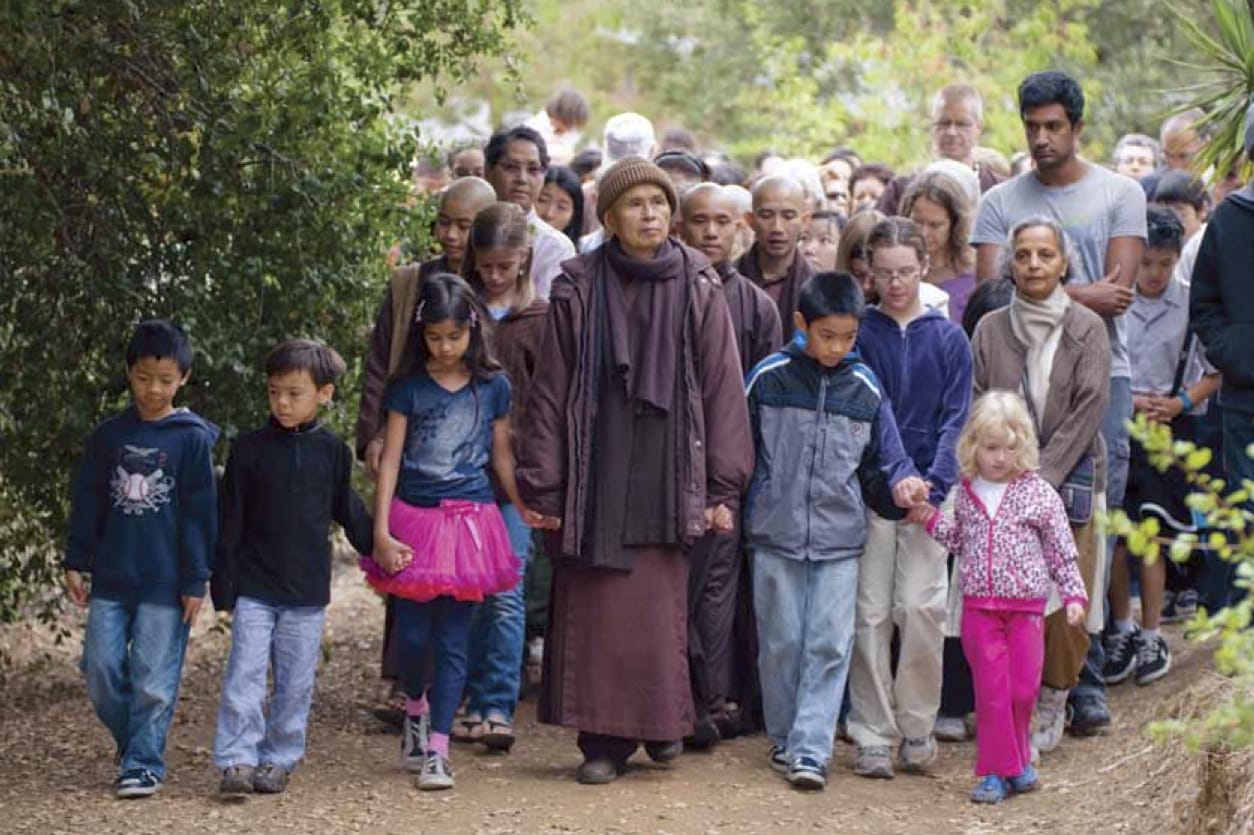
As I walked slowly and mindfully through a green oak forest this morning, a brilliant
red-orange sun rose on the horizon. It immediately evoked for me images of India, where a
group of us joined Thich Nhat Hanh the year before last to visit the sites where the Buddha
taught. On one walk to a cave near Bodh Gaya, we stopped in a field surrounded by rice paddies
and recited this poem:

Peace is every step.

The shining red sun is my heart.

Each flower smiles with me.

How green, how fresh all that grows.


How cool the wind blows.

Peace is every step.

It turns the endless path to joy.

These lines summarize the essence of Thich Nhat Hanh’s message — that
peace is not external or to be sought after or attained. Living mindfully,
slowing down and enjoying each step and each breath, is enough. Peace is
already present in each step, and if we walk in this way, a flower will bloom
under our feet with every step. In fact the flowers will smile at us and wish
us well on our way.

I met Thich Nhat Hanh in 1982 when he attended the Reverence for Life
conference in New York. I was one of the first American Buddhists he had
met, and it fascinated him that I looked, dressed, and, to some extent, acted
like the novices he had trained in Vietnam for two decades. When my
teacher, Richard Baker-roshi, invited him to visit our meditation center in
San Francisco the following year, he happily accepted, and this began a new
phase in the extraordinary life of this gentle monk, whom Baker-roshi
characterized as “a cross between a cloud, a snail, and a piece of heavy
machinery — a true religious presence.”

Thich Nhat Hanh was born in central Vietnam in 1926 and was ordained a
Buddhist monk in 1942, at the age of sixteen, first eight years later, he
co-founded what was to become the foremost center of Buddhist studies in
South Vietnam, the An Quang Buddhist Institute.

In 1961, Nhat Hanh came to the United States to study and teach
comparative religion at Columbia and Princeton Universities. But in 1963,
his monk-colleagues in Vietnam telegrammed him to come home to join
them in their work to stop the war following the fall of the oppressive Diem
regime. He immediately returned and helped lead one of the great
nonviolent resistance movements of the century, based entirely on Gandhian
principles.

In 1964, along with a group of university professors and students in
Vietnam, Thich Nhat Hanh founded the School of Youth for Social Service,
called by the American press the “little Peace Corps,” in which teams of
young people went into the countryside to establish schools and health
clinics, and later to rebuild villages that had been bombed. By the time of the
fall of Saigon, there were more than 10,000 monks, nuns, and young social
workers involved in the work. In the same year, he helped set up what was to
become one of the most prestigious publishing houses in Vietnam, La Boi
Press. In his books and as editor-in-chief of the official publication of the


Unified Buddhist Church, he called for reconciliation between the warring
parties in Vietnam, and because of that his writings were censored by both
opposing governments.

In 1966, at the urging of his fellow monks, he accepted an invitation from
the Fellowship of Reconciliation and Cornell University to come to the U.S.
“to describe to [us] the aspirations and the agony of the voiceless masses of
the Vietnamese people” (New Yorker, June 25, 1966). He had a densely
packed schedule of speaking engagements and private meetings, and spoke
convincingly in favor of a ceasefire and a negotiated settlement. Martin
Luther King, Jr. was so moved by Nhat Hanh and his proposals for peace
that he nominated him for the 1967 Nobel Peace Prize, saying, “I know of
no one more worthy of the Nobel Peace Prize than this gentle monk from
Vietnam.” Largely due to Thich Nhat Hanh’s influence, King came out
publicly against the war at a press conference, with Nhat Hanh, in Chicago.

When Thomas Merton, the well-known Catholic monk and mystic, met
Thich Nhat Hanh at his monastery, Gethsemani, near Louisville, Kentucky,
he told his students, “Just the way he opens the door and enters a room
demonstrates his understanding. He is a true monk.” Merton went on to
write an essay, “Nhat Hanh Is My Brother,” an impassioned plea to listen to
Nhat Hanh’s proposals for peace and lend full support for Nhat Hanh’s
advocacy of peace. After important meetings with Senators Fulbright and
Kennedy, Secretary of Defense McNamara, and others in Washington, Thich
Nhat Hanh went to Europe, where he met with a number of heads of state
and officials of the Catholic church, including two audiences with Pope Paul
VI, urging cooperation between Catholics and Buddhists to help bring peace
to Vietnam.

In 1969, at the request of the Unified Buddhist Church of Vietnam, Thich
Nhat Hanh set up the Buddhist Peace Delegation to the Paris Peace Talks.
After the Peace Accords were signed in 1973, he was refused permission to
return to Vietnam, and he established a small community a hundred miles
southwest of Paris, called “Sweet Potato.” In 1976-77, Nhat Hanh conducted
an operation to rescue boat people in the Gulf of Siam, but hostility from the
governments of Thailand and Singapore made it impossible to continue. So
for the following five years, he stayed at Sweet Potato in retreat —
meditating, reading, writing, binding books, gardening, and occasionally
receiving visitors.

In June 1982, Thich Nhat Hanh visited New York, and later that year
established Plum Village, a larger retreat center near Bordeaux, surrounded
by vineyards and fields of wheat, com, and sunflowers. Since 1983 he has


traveled to North America every other year to lead retreats and give lectures
on mindful living and social responsibility, “making peace right in the
moment we are alive.”

Although Thich Nhat Hanh cannot visit his homeland handwritten copies
of his books continue to circulate illegally in Vietnam. His presence is also
felt through his students and colleagues throughout the world who work full-
time trying to relieve the suffering of the desperately poor people of
Vietnam, clandestinely supporting hungry families and campaigning on
behalf of writers, artists, monks, and nuns who have been imprisoned for
their beliefs and their art. This work extends to helping refugees threatened
with repatriation, and sending material and spiritual aid to refugees in the
camps of Thailand, Malaysia, and Hong Kong.

Now sixty-four years old, yet looking twenty years younger, Thich Nhat
Hanh is emerging as one of the great teachers of the twentieth century. In the
midst of our society’s emphasis on speed, efficiency, and material success,
Thich Nhat Hanh’ s ability to walk calmly with peace and awareness and to
teach us to do the same has led to his enthusiastic reception in the West. Al-
though his mode of expression is simple, his message reveals the
quintessence of the deep understanding of reality that comes from his
meditations, his Buddhist training, and his work in the world.

His way of teaching centers around conscious breathing — the awareness
of each breath — and, through conscious breathing, mindfulness of each act
of daily life. Meditation, he tells us, is not just in a meditation hall. It is just
as sacred to wash the dishes mindfully as to bow deeply or light incense. He
also tells us that forming a smile on our face can relax hundreds of muscles
in our body — he calls it “mouth yoga” — and in fact, recent studies have
shown that when we flex our facial muscles into expressions of joy, we do
indeed produce the effects on our nervous system that go with real joy.
Peace and happiness are available, he reminds us, if we can only quiet our
distracted thinking long enough to come back to the present moment and
notice the blue sky, the child’s smile, the beautiful sunrise. “If we are
peaceful, if we are happy, we can smile, and everyone in our family, our
entire society, will benefit from our peace.”

Peace Is Every Step is a book of reminders. In the rush of modern life, we
tend to lose touch with the peace that is available in each moment. Thich
Nhat Hanh’s creativity lies in his ability to make use of the very situations
that usually pressure and antagonize us. For him, a ringing telephone is a
signal to call us back to our true selves. Dirty dishes, red lights, and traffic
jams are spiritual friends on the path of mindfulness. The most profound


satisfactions, the deepest feelings of joy and completeness lie as close at
hand as our next aware breath and the smile we can form right now.

Peace Is Every Step was assembled from Thich Nhat Hanh’s lectures,
published and unpublished writings, and informal conversations, by a small
group of friends — Therese Fitzgerald, Michael Katz, Jane Hirshfield, and
myself — working closely with Thay Nhat Hanh (pronounced “tie” — the
Vietnamese word for “teacher”) and with Leslie Meredith, our attentive,
thorough, and sensitive editor at Bantam. Patricia Curtan provided the
beautiful dandelion. Special thanks to Marion Tripp, who wrote the
“Dandelion Poem.”

This book is the clearest and most complete message yet of a great
bodhisattva, who has dedicated his life to the enlightenment of others. Thich
Nhat Hanh’s teaching is simultaneously inspirational and very practical. I
hope the reader enjoys this book as much as we have enjoyed making it
available.

Arnold Kotler, France




No comments:
Post a Comment